

In a context of strong interdependence between smart grids and cellular networks, Enedis, in collaboration with Orange, Nokia, EDF, and Wavestone, has just published a white paper on cellular network resilience to support the resilience of electrical grids.
The objective is to analyze the opportunities of a low-frequency radio network (450 MHz or equivalent) to provide connectivity for essential services, particularly maintenance and restoration of the electrical grid. The next step: to test this in a pilot region.
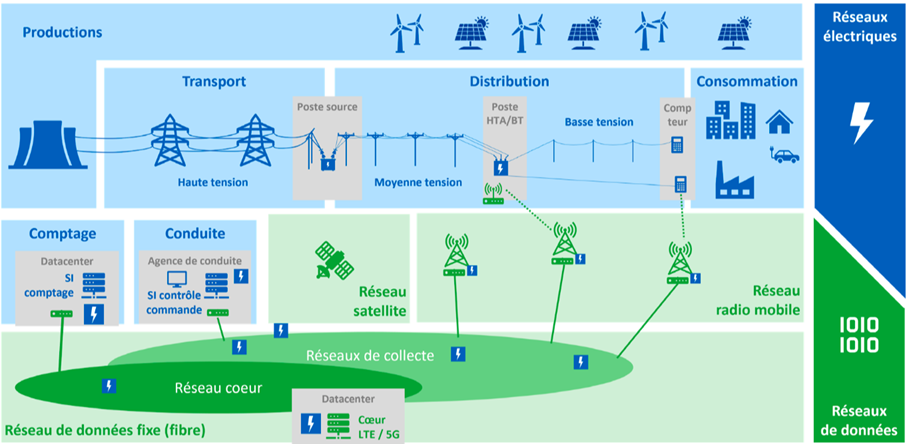
Managing renewable energy parks and consumption substations to facilitate supply/demand matching by control centers (SCADA system), facilitating fault identification on the network, streamlining metering and data collection… data collection throughout the electrical grid offers numerous use cases, provided it is supported by a robust and resilient telecom infrastructure.
In a context of non-renewal of the copper network and transition to a fiber optic network (less dense in rural areas and with extension costs often ten times higher than implementing radio connectivity), Enedis already relies heavily on cellular networks for network control at medium/low voltage substations and for metering. However, cellular networks are less resilient in the context of power outages (exacerbated by the climate crisis) than fiber and copper networks, a challenge shared by telecom operators seeking to minimize downtime for their infrastructure.
The key challenge for Enedis is to determine whether any off-the-shelf telecom technology solutions could meet its business requirements:
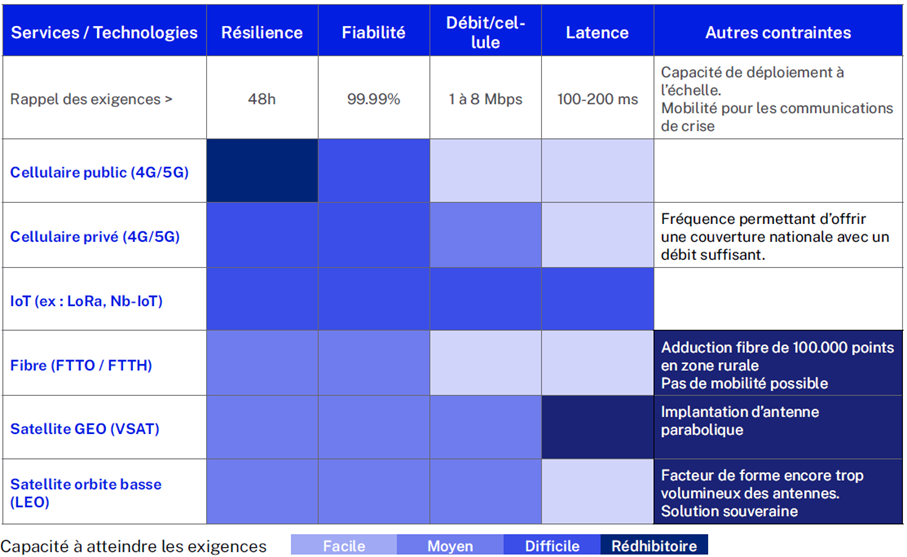
It appears that no off-the-shelf telecom service can meet the requirements, so Enedis and its partners are studying the deployment of a private network with dedicated antennas using a low frequency to allow national coverage with a minimum of high points:
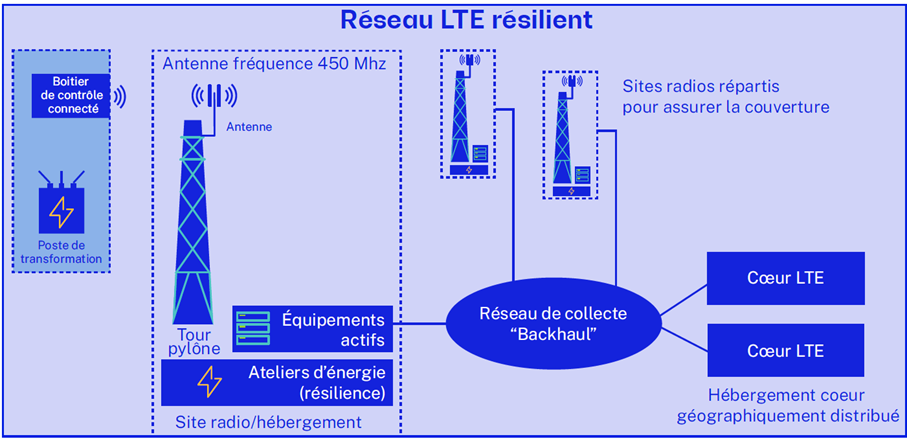
Beyond the control and monitoring of the electrical grid, the deployment of such a low-frequency LTE network could also help Enedis to:
Overcome the obsolescence of its 70 MHz DMR (Digital Mobile Radio) network, used for controlling remotely operated switching devices, and ensure voice communication between control centers and field technicians.
Improve the overall availability of the communication chain for transmitting increasingly complex metering data (more precise monitoring of load curves, load shedding orders) from the MV/LV substation concentrators to the data centers.
Such a solution is supported by concrete advantages:
Similar initiatives in other European countries
A dynamic ecosystem driven by the 450 MHz Alliance
Mature, sustainable, and scalable 3GPP technology
450 MHz frequencies enabling extensive coverage with few high points due to long-distance wave propagation and good penetration inside buildings
However, it also comes with several challenges:
Securing frequencies that meet the need
Implementing near-national coverage
Leveraging the complementarity of the public and private networks
Sharing investments and infrastructure
Ensuring resilience even in the event of major electrical incidents
To learn more, consult the white paper available here: https://agurre.fr/sites/default/files/2025-03/Enedis_LB_012.pdf