


[leap_dropcap style=”style-1″]L[/leap_dropcap]e développement des Smart Grids, sur fond de mutation en profondeur des politiques et des systèmes énergétiques, ne pouvait laisser les sciences sociales indifférentes. Un nombre croissant de chercheurs en sciences sociales rejoignent les économistes et passent les Smart Grids au prisme de leurs disciplines. Cet article vous propose une compilation de références pour approfondir le sujet.
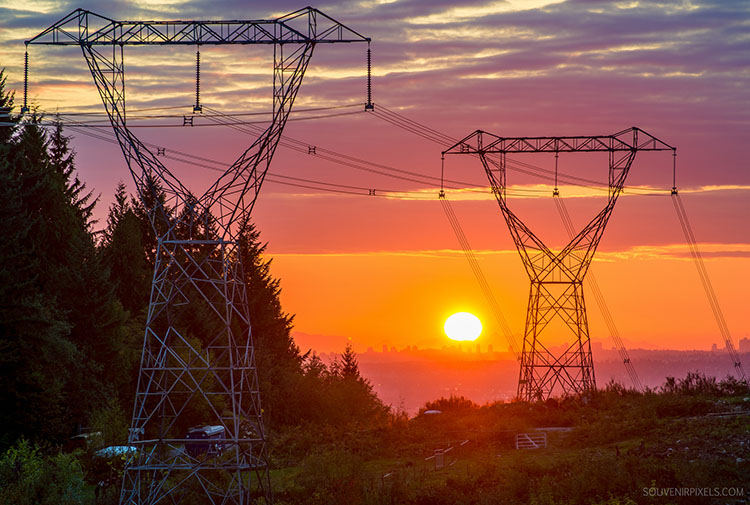 Couché de soleil derrière un réseau électrique – James Wheeler[1] sur Flickr en CC
Les sociologues de l’innovation, des usages, de la Ville et du logement observent les comportements des consommateurs et les jeux d’acteurs. Les politologues ou économistes, examinent les politiques publiques, à différentes échelles, décryptent les stratégies industrielles et s’interrogent sur les régulations et les incitations.
Cet élan vise, entre autres, à répondre aux attentes des porteurs de projets Smart Grids, qui s’intéressent de manière croissante aux enseignements sociologiques et économiques. En effet, que cela soit pour faciliter l’adoption des nouvelles technologies ou à en défendre l’acceptabilité auprès de parties-prenantes variées, les apports des sciences, dites molles, permettent dans de nombreux cas de faire la différence et de garantir le bon déroulement d’un projet.
Le Centre de mathématiques appliquées (CMA) de Mines ParisTech est l’un foyers les plus actifs de recherche autour des Smart Grids. Sa directrice, Nadia Maïzi, Titulaire de la chaire Modélisation prospective au service du développement durable, y a dirigé, notamment la thèse de Stéphanie BOUCKAERT consacrée à la « Contribution des Smart Grids à la transition énergétique : évaluation dans des scénarios long terme » (2013)[2].
La prestigieuse revue Energy Policy accueille désormais régulièrement des travaux de synthèse qui portent sur différents sujets clés du développement des Smart Grids :
[leap_ul][leap_li icon=”arrow-circle-right” iconcolor=”#a2b731″]L’ajustement de l’offre et la demande[3],[/leap_li][leap_li icon=”arrow-circle-right” iconcolor=”#a2b731″]La gestion des périodes de pointes[4],[/leap_li][leap_li icon=”arrow-circle-right” iconcolor=”#a2b731″]Les approches de microgrids[5],[/leap_li][leap_li icon=”arrow-circle-right” iconcolor=”#a2b731″]Les politiques publiques[6],[/leap_li][leap_li icon=”arrow-circle-right” iconcolor=”#a2b731″]Les freins à la transformation des systèmes énergétiques[7],[/leap_li][leap_li icon=”arrow-circle-right” iconcolor=”#a2b731″]Le rôle des Etats dans la transition énergétique[8]),[/leap_li][leap_li icon=”arrow-circle-right” iconcolor=”#a2b731″]Les comportements des consommateurs[9],[/leap_li][leap_li icon=”arrow-circle-right” iconcolor=”#a2b731″]Les facteurs d’incitation à la consom’action[10],[/leap_li][leap_li icon=”arrow-circle-right” iconcolor=”#a2b731″]Les pratiques domestiques émergeantes[11],[/leap_li][leap_li icon=”arrow-circle-right” iconcolor=”#a2b731″]La gouvernance des Smart Grids[12].[/leap_li][/leap_ul]
Lors des Journées internationales de sociologie de l’énergie – qui se sont tenues à l’Université de Tours (Université François-Rabelais) en juillet 2015 – avec pour titre : « les sociétés contemporaines à l’épreuve des transitions énergétiques », près d’une trentaine de communications portaient sur le contexte et les conditions de développement des Smart Grids. Quatre d’entre elles étaient spécifiquement consacrées aux Smart Grids :
[leap_ul][leap_li icon=”arrow-circle-right” iconcolor=”#a2b731″]« enjeux d’acceptabilité et conditions d’appropriation des Smart Grids »[13],[/leap_li][leap_li icon=”arrow-circle-right” iconcolor=”#a2b731″]« Acceptation sociale ou conditions socio-politiques, collectives et marchandes de développement d’innovations dans le domaine de l’énergie ?»[14],[/leap_li][leap_li icon=”arrow-circle-right” iconcolor=”#a2b731″]« Mesurer, tarifer, vendre l’électricité. La place du client particulier dans les processus de conception et de gestion du compteur d’électricité communicant»[15],[/leap_li][leap_li icon=”arrow-circle-right” iconcolor=”#a2b731″]« La technologie est la réponse. Mais quelle était la question ? »[16].[/leap_li][/leap_ul]
Un autre indicateur de la mobilisation intellectuelle des sciences sociales autour des Smart Grids est celui des doctorats. Et particulièrement les jeunes chercheurs qui réalisent en ce moment des thèses très spécifiques :
[leap_ul][leap_li icon=”arrow-circle-right” iconcolor=”#a2b731″]Sciences économiques : Tarification Dynamique et Smart Grids : une analyse expérimentale des comportements des ménages en matière de consommation électrique[17],[/leap_li][leap_li icon=”arrow-circle-right” iconcolor=”#a2b731″]Sciences de l’aménagement : Smart Grids, de l’échelle du quartier a celle de la ville : pour une rationalisation des consommations et des productions locales de l’énergie[18],[/leap_li][leap_li icon=”arrow-circle-right” iconcolor=”#a2b731″]Sciences politiques : L’impact du compteur communicant Linky sur les politiques publiques de l’énergie et du développement durable en France[19],[/leap_li][leap_li icon=”arrow-circle-right” iconcolor=”#a2b731″]Sociologie : Des Smart Grids au compteur communicant d’électricité : genèse et expérimentations d’un outil de relation de service[20],[/leap_li][leap_li icon=”arrow-circle-right” iconcolor=”#a2b731″]Urbanisme : Impératifs climatiques et énergétiques, Smart Grids et péréquation territoriale: quelle gouvernance énergétique territoriale de la distribution de l’électricité ?[21].[/leap_li][/leap_ul]
L’ensemble de ces travaux s’insère dans une volonté forte de la filière des Smart Grids de prendre en compte l’ensemble des paramètres sociaux et économiques dans la mise au point d’une offre française unique. Si les apports des nouvelles technologies sont indéniables, leur utilisation à bon escient dans une grande variété de contextes n’en reste pas moins un challenge à part entière, ce à quoi les acteurs des Smart Grids en France sont activement mobilisés.
[leap_gap height=”20px” ]
ITEMS International pour Think Smartgrids
[leap_gap height=”150px” ]
[1] https://www.flickr.com/photos/24128704@N08/10355017174/,
[2] https://tel.archives-ouvertes.fr/pastel-00959266/document,
[3] Ghasem Derakhshan, Heidar Ali Shayanfar, Ahad Kazemi, The optimization of demand response programs in smart grids, Energy Policy, Volume 94, July 2016, Pages 295-306, ISSN 0301-4215, http://dx.doi.org/10.1016/j.enpol.2016.04.009,
[4] A. Zhuk, Yu. Zeigarnik, E. Buzoverov, A. Sheindlin, Managing peak loads in energy grids: Comparative economic analysis, Energy Policy, Volume 88, January 2016, Pages 39-44, ISSN 0301-4215, http://dx.doi.org/10.1016/j.enpol.2015.10.006,
[5] Ahmad F. Taha, Nadim A. Hachem, Jitesh H. Panchal, A Quasi-Feed-In-Tariff policy formulation in micro-grids: A bi-level multi-period approach, Energy Policy, Volume 71, August 2014
[6] Stephen Hall, Timothy J. Foxon, Values in the Smart Grid: The co-evolving political economy of smart distribution, Energy Policy, Volume 74, November 2014, Pages 600-609, ISSN 0301-4215, http://dx.doi.org/10.1016/j.enpol.2014.08.018,
[7] Stefan Muench, Sebastian Thuss, Edeltraud Guenther, What hampers energy system transformations? The case of smart grids, Energy Policy, Volume 73, October 2014,
[8] Daphne Ngar-yin Mah, Yun-Ying Wu, Jasper Chi-man Ip, Peter Ronald Hills, The role of the state in sustainable energy transitions: A case study of large smart grid demonstration projects in Japan, Energy Policy, Volume 63, December 2013,
[9] Marta A.R. Lopes, Carlos Henggeler Antunes, Kathryn B. Janda, Paulo Peixoto, Nelson Martins, The potential of energy behaviours in a smart(er) grid: Policy implications from a Portuguese exploratory study, Energy Policy, Volume 90, March 2016, Pages 233-245, ISSN 0301-4215,
[10] Chan-Kook Park, Hyun-Jae Kim, Yang-Soo Kim, A study of factors enhancing smart grid consumer engagement, Energy Policy, Volume 72, September 2014,
[11] Joeri Naus, Gert Spaargaren, Bas J.M. van Vliet, Hilje M. van der Horst, Smart grids, information flows and emerging domestic energy practices, Energy Policy, Volume 68, May 2014,
[12] Christopher Koliba, Mercy DeMenno, Nancy Brune, Asim Zia, The salience and complexity of building, regulating, and governing the smart grid: Lessons from a statewide public–private partnership, Energy Policy, Volume 74, November 2014,
[13] Grandclément Catherine (sociologue GRETS, EDF R&D), Nadaï Alain (sociologue CIRED-CNRS)
[14] Fournier Pierre (Aix-Marseille Université/LAMES, UMR 7305, CNRS), Rychen Frédéric (Aix-Marseille Université/GREQAM, UMR 7316, CNRS-EHESS)
[15] Danieli Aude (doctorante CIFRE en sociologie – ENPC/LATTS ; UPEM/CNRS ; EDF R&D /GRETS)
[16] Caraës Marie-Haude (Directrice, École supérieure des Beaux-Art de Tours)
[17] Penelope Buckley, Université Grenoble Alpes
[18] Farinaz Falaki, Université de Tours
[19] Thoma Lamb, Université Paris 2
[20] Olivier Coutard, Université Paris Est
[21] Bernard Pecqueur, Université Grenoble Alpes